Building a Full-Stack Design Function at Sense
August 2025
“Design that smooths edges is helpful. Design that removes barriers is transformative.”
This belief guided how we turned design at Sense from a service team into a full-stack, strategic function — one that now spans discovery to go-to-market and helps shape the company’s future.
From Visualizers to Value Creators
When I joined Sense, design was three mid-level designers supporting four fragmented products.
Their work began when a product manager handed over a PRD — features already defined, timelines already set. Designers were expected to visualize those requirements.
But that’s rarely how great product work happens. Product discovery is messy. Problems aren’t always clearly defined. The best solutions come from iterating together — design, product, and engineering — before the requirements even exist.
That’s where the transformation began: reimagining design’s role as full-stack — not a stage in delivery, but a strategic layer that touches every part of the product lifecycle.
What “Full-Stack Design” Really Means
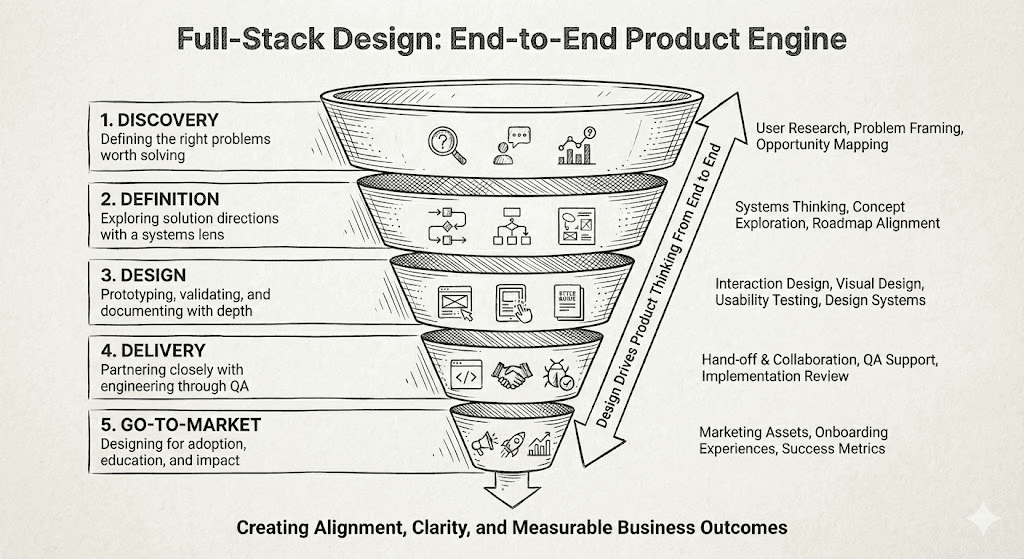
For me, full-stack design means design isn’t a stop along the way — it’s part of the engine that drives product thinking from end to end.
Design at Sense now contributes at five levels:
Discovery – Defining the right problems worth solving.
Definition – Exploring solution directions with a systems lens.
Design – Prototyping, validating, and documenting with depth.
Delivery – Partnering closely with engineering through QA.
Go-to-Market – Designing for adoption, education, and impact.
Visual: (Insert: “Full-Stack Design Funnel” — a layered funnel from Discovery → GTM, showing where design contributes at each stage.)
This model ensures that design isn’t just creating artifacts — it’s creating alignment, clarity, and measurable business outcomes.
Diagnosing the Gaps
Early on, a few patterns stood out:
Designers were waiting for direction instead of co-shaping it.
Product managers were over-burdened as the only voices in discovery.
Engineering feedback came too late in the cycle.
Every product looked and felt different — no shared design language, no shared principles.
Design lacked visibility and confidence. The rest of the org saw design as a downstream “finishing function.”
That had to change — both structurally and culturally.
Redefining Design’s Role Across the Lifecycle
Discovery — From Receivers to Explorers
The first shift was getting design involved upstream.
We began running joint discovery sessions — designers, PMs, and engineers together — to frame opportunities, understand customer pain, and explore problem spaces.
Designers started leading future-of-product prototypes — lightweight explorations that helped visualize where Sense could go next.
These weren’t about pixel-perfect screens; they were conversation starters about direction and ambition.
Example: Future-state prototypes helped align leadership around long-term vision — scaling existing products like Automation and CRM, while seeding new 0→1 concepts such as Voice AI copilots.
For the first time, design was leading customer research for these initiatives, something that had historically been PM-owned.
"This gave design leverage and a legitimate role in shaping the roadmap, not just illustrating it."
Definition — Shaping Concepts, Not Just Features
As design earned trust upstream, we formalized the “Concept Design” phase — a lightweight framework for exploring multiple solution paths before committing to one.
We introduced tools like Design Briefs and Concept Reviews — structured artifacts where design, product, and engineering could align on:
User problem framing
Solution options and trade-offs
Technical feasibility
System dependencies
This made the process more intentional and less reactive.
It also led to the federated research model. Customer Success, Solutions Consulting, and Sales teams began engaging directly with design — validating directions, collecting insights, and co-creating feedback loops.
Research was no longer a bottleneck; it became a distributed, collaborative function across Sense.
Design Systems — The Cultural Catalyst
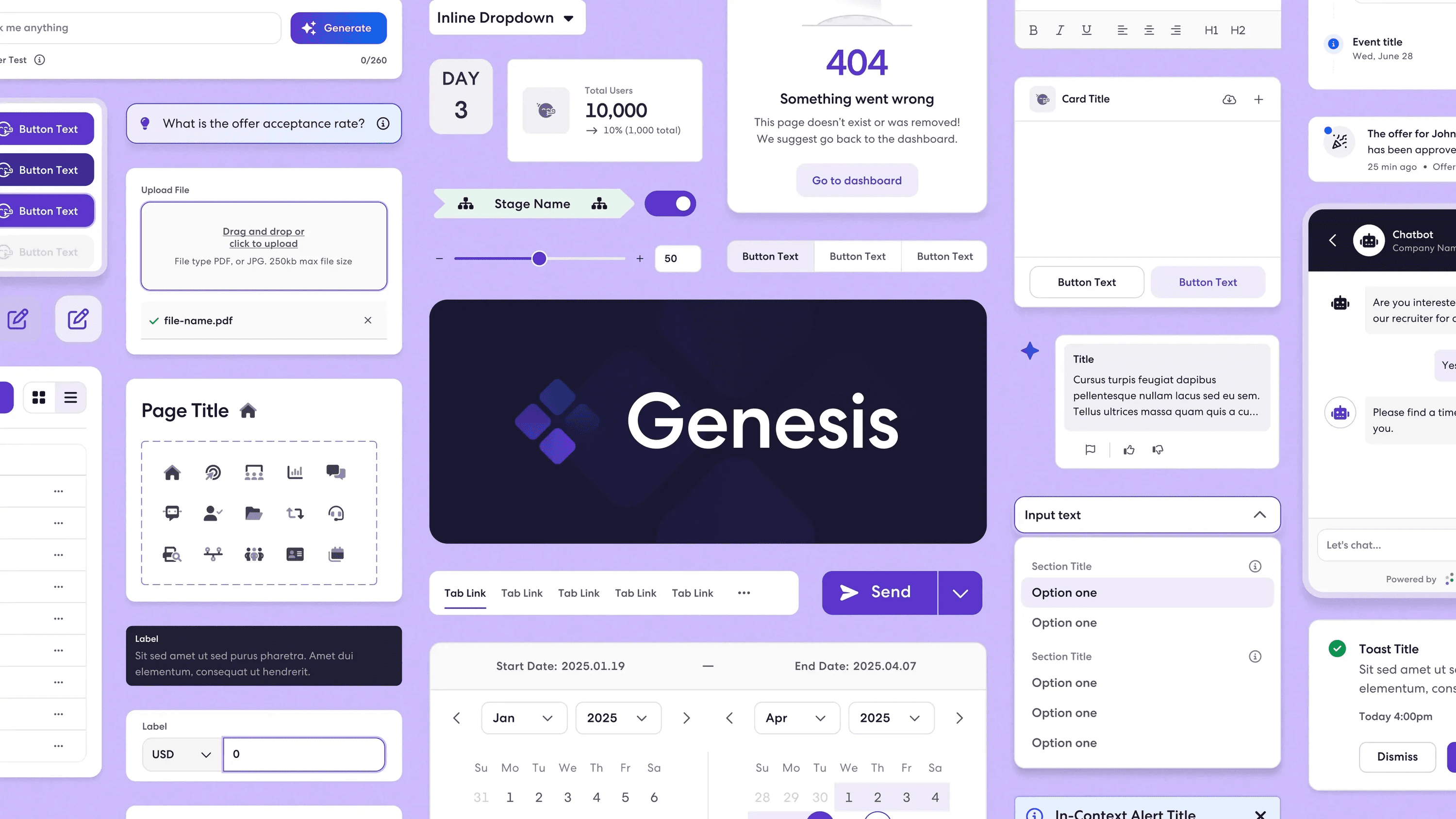
The Genesis Design System was the backbone of this transformation.
At first, Genesis was simply a modernization effort — unify UI, improve consistency, speed up builds.
But it became something more: a cultural movement that reignited pride in craft and created a shared visual language across the org.
New incarnations of existing products — the refreshed Automation builder, talent CRM, Messaging app for recruiters — began to look and feel cohesive.
Stakeholders could see the progress. There was tangible energy.
Customer Success and Solutions teams began showing Genesis-powered prototypes in demos, celebrating design’s impact in front of customers.
Delivery — Raising the Bar on Quality
As the team matured, our goal shifted from output to outcomes.
We redefined delivery not as “handoff” but as co-ownership.
Designers worked side-by-side with engineers through build, QA, and release — inspecting edge cases, refining micro-interactions, and ensuring design intent carried through to production.
We introduced rituals like:
Design team QA – quick, visual feedback sessions before sprints closed.
Bug Bash Showcases – making product quality a shared win, not just a design concern.
Design–Eng pairing for complex features (especially in Automation and Voice AI).
The result: faster iteration cycles, fewer misalignments, and consistently higher polish.
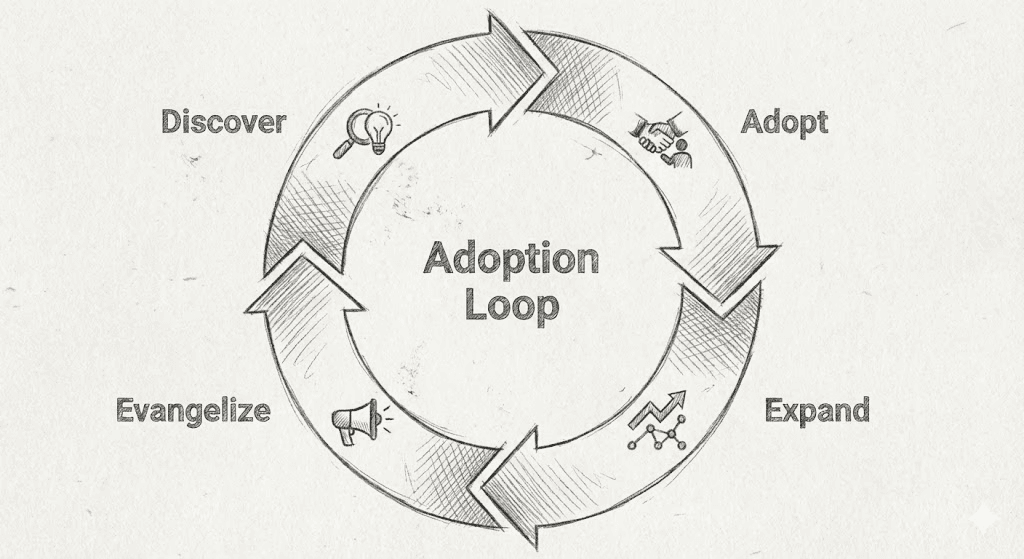
Go-to-Market — Designing for Adoption
The next horizon was impact.
Commercial shifts — contraction on the enterprise side and a push toward self-serve — created urgency for better onboarding and in-product education.
That’s when we built a Growth & Adoption pillar within design, responsible for activation, upsells, and product education.
Design began shaping:
First-run experiences and onboarding flows
In-product walkthroughs and tooltips
Feature discovery surfaces tied to metrics
“Aha moment” journeys to drive activation
By collaborating closely with PMM and CS, design became a growth lever — using empathy, data, and storytelling to reduce churn and increase expansion.
Building the Muscle — People, Process, and Systems
Scaling a full-stack design function wasn’t just about process — it required new muscles.
People
We grew from 3 to 15+ designers — spanning product, brand, systems & ops, and research. We hired for curiosity, craft & grit, not titles. Designers who could zoom out to strategy and zoom in to pixels.
Process
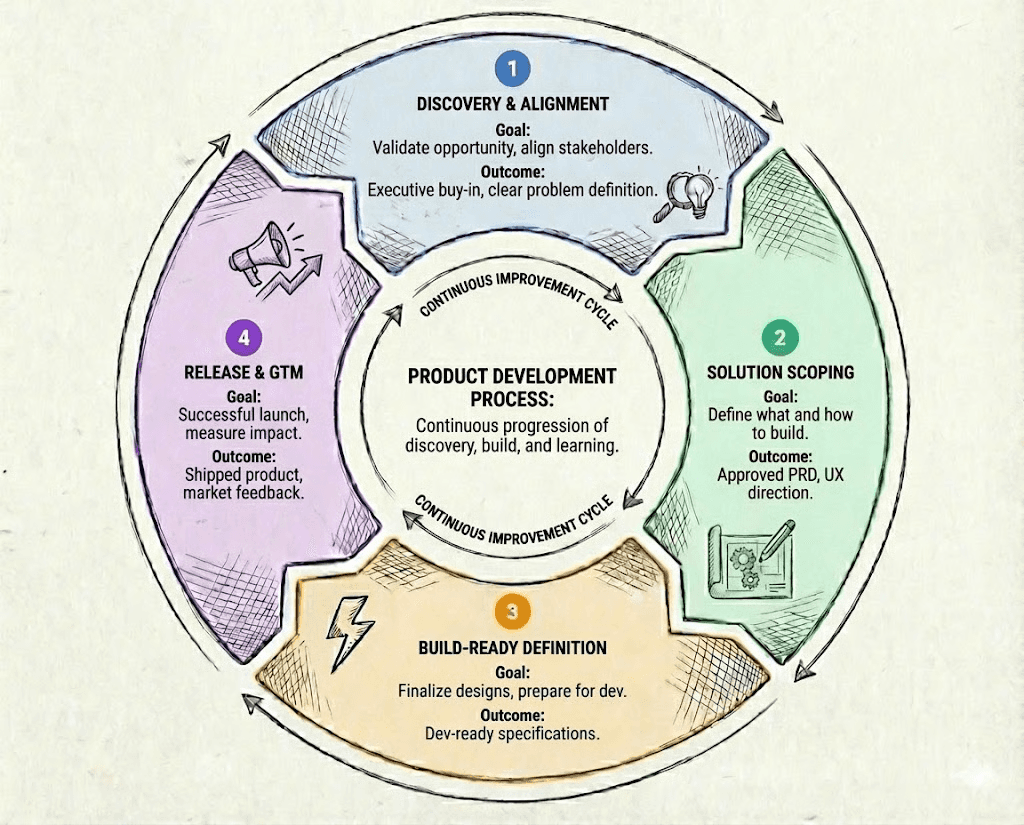
We introduced a four-stage review model — from Concept → Definition → Finalization → Delivery.
Each stage had clear checkpoints, shared rituals, and defined ownership. We normalized feedback as fuel — through cross-functional design critiques, async reviews, and product–design syncs that built mutual trust.
Systems
Genesis evolved alongside our design ops stack — standardized Figma libraries, design QA frameworks, and metrics dashboards.
Everything connected back to velocity, quality, and user impact.
The Transformation in Numbers
Dimension
2021
2025
NPS
But numbers only tell part of the story.
The real impact was cultural — design gained a voice in conversations about strategy, growth, and vision.
Lessons in Leading Change
Lead with clarity, not control. Empower designers to think like PMs and engineers — curiosity is the connective tissue.
Rituals build trust. Shared reviews, consistent feedback, and transparency make collaboration effortless.
Visibility creates leverage. The more people see the craft, the more they value it. Genesis didn’t just modernize the UI — it made design tangible.
Momentum compounds. Each success — a prototype that clarifies vision, a launch that boosts adoption — becomes fuel for the next.