The 4 Hats of Design Leadership
Feb 2025
Design Leadership Framework for Scaling Impact
In my experience leading design organizations across FinTech, HRTech, and enterprise SaaS, I’ve found that the role of a design leader extends far beyond approving pixels or managing a team of creatives . It requires a shapeshifter mentality—the ability to pivot between strategy, mentorship, operations, and diplomacy.
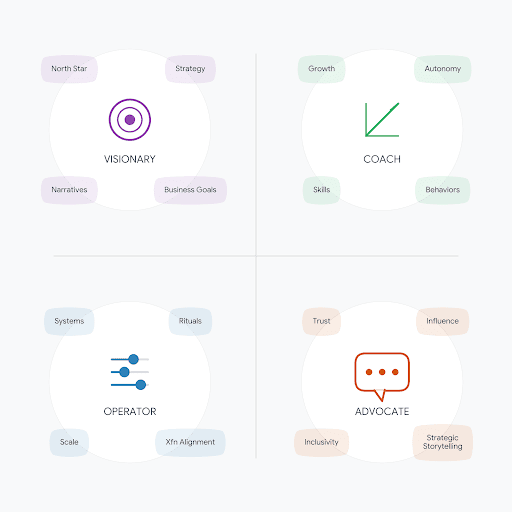
I believe that successful design leadership can be distilled into four distinct modalities, or "hats," that I wear daily: The Visionary, The Coach, The Operator, and The Advocate.
1. The Visionary
For me, the Visionary hat is about defining where we are headed and why . It involves translating business strategy and goals into concrete product and brand narratives .
I view this as the ultimate superpower of a design organization: establishing an "experience North Star" . We have the unique ability to visualize what the future looks like before it is built.
How I apply this: At Sense, this meant unifying our product ecosystem across CRM, sourcing, and recruiter productivity . By using prototyping to visualize a connected ecosystem, I helped create a vision that bridged the gap between high-level strategy and execution .
2. The Coach
While the Visionary focuses on the product, the Coach focuses on the people. I focus on growing my team through feedback and clarity .
When wearing this hat, I look at two distinct tracks:
Skills: Up-leveling craft, research capabilities, product quality, and strategy .
Behaviors: Encouraging collaboration, ownership, and operational excellence .
How I apply this: My goal is to foster autonomy. At Sense, I inherited a team of mid-level designers and coached them into managers and staff-level designers who now own end-to-end strategic areas . I proactively track how team members index on core skills and work with them specifically where they need development .
3. The Operator
The Operator hat ensures that quality design happens at the desired velocity . I focus on building "systems of excellence"—the infrastructure that allows the team to scale .
This includes implementing design systems, establishing team rituals, refining management practices, and driving cross-functional alignment . Without the Operator, the Visionary’s ideas cannot be executed efficiently.
How I apply this: Building a robust design system has been foundational to my team's success. For example, by building our design system from the ground up, we achieved a metric where we save up to 30 hours per developer per month when building with existing components .
4. The Advocate
Finally, the Advocate hat is about building trust and influence across organizational boundaries, often without formal authority . This is crucial for aligning executives and ensuring design has a seat at the table.
For me, advocacy also encompasses inclusivity—both in the products we build (like baking accessibility into our design system) and in how the team operates, ensuring that even less vocal team members have a stage to contribute .
How I apply this: I use "strategic storytelling" to align stakeholders . For instance, during a major CRM redesign, I had to advocate heavily to ensure the new product wasn't just buried in a legacy navigation but was de-siloed and integrated into the core platform .
Balancing all four modalities
I rarely wear these hats in isolation. In transforming a legacy ATS into an AI-native CRM, I had to rotate through them rapidly :
As a Visionary: I moved us from simply modernizing an interface to establishing a "self-driving car of recruitment" .
As an Operator: I managed shared roadmaps across three distinct product pods and introduced new cross-functional rituals .
As an Advocate: I fought for features like dynamic talent pools over static folders because our research showed that is what enterprise users actually needed .
By balancing these four modalities, I’ve been able to transition my design organizations from service providers into strategic drivers that sit in the driver's seat of product development .